For months, the tech world had one recurring question: Why was Apple moving so slowly on AI?
While competitors were racing ahead with generative AI tools, Apple appeared cautious—almost silent. That narrative has now changed dramatically.
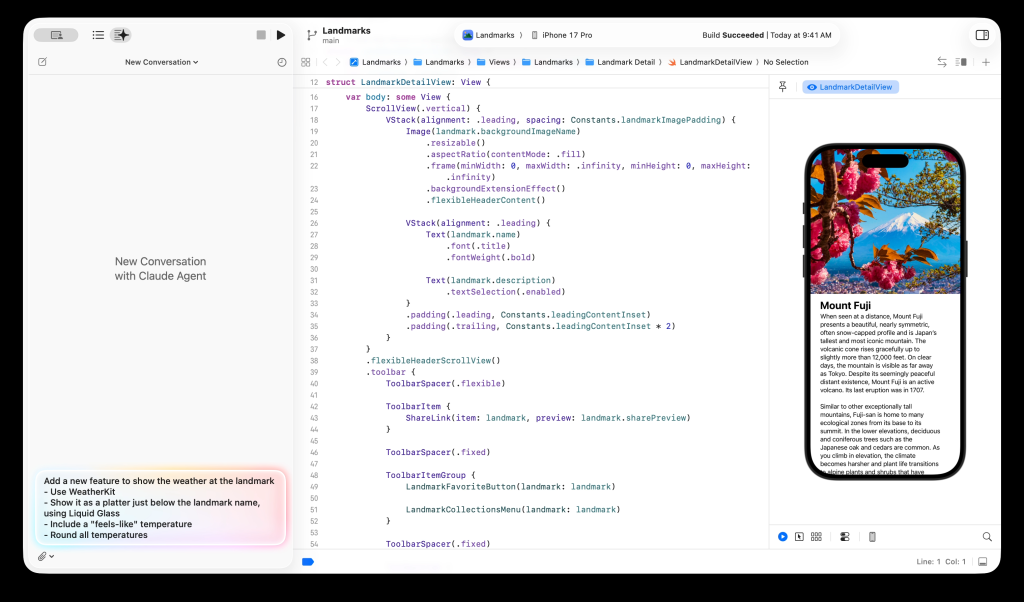
With the release of Xcode 26.3, Apple has taken a decisive step into agentic AI, bringing Anthropic’s Claude AI and OpenAI’s Codex directly into its app development ecosystem. For developers, this is not just another feature update. It marks a fundamental shift in how apps can be built, tested, and maintained on Apple platforms.
And for Claude AI, this moment could be a turning point.
Apple’s AI Strategy Finally Accelerates
Apple’s approach to artificial intelligence has always been different. Instead of rushing half-finished tools into the market, the company prefers controlled, tightly integrated systems. However, that restraint also led to criticism, with analysts questioning whether Apple was falling behind in the AI race.
That perception started changing when Apple began upgrading Siri with external AI support. Now, with agentic coding built into Xcode, Apple is signaling something much bigger: AI is becoming a core part of its developer workflow, not just a user-facing feature.
By partnering with Anthropic and OpenAI, Apple is effectively opening its development environment to some of the most advanced AI models available today.
What Is Agentic Coding and Why It Matters
Agentic coding goes beyond simple code suggestions or autocomplete features. Instead of reacting to individual prompts, AI agents can work toward broader goals with a degree of autonomy.
In practical terms, this means AI tools inside Xcode can now:
- Break down complex development tasks into smaller steps
- Explore project structures and metadata
- Search official Apple documentation automatically
- Write, modify, and refactor code
- Run tests, identify errors, and fix bugs
- Make decisions based on the app’s architecture
Rather than acting like a passive assistant, the AI behaves more like a junior developer working alongside the human coder.
Why Claude AI’s Inclusion Is a Big Deal
Claude AI has steadily built a reputation for handling long context, structured reasoning, and safer outputs—qualities that matter deeply in professional environments. Its inclusion in Xcode places Claude in front of millions of Apple developers worldwide.
This is significant for several reasons:
- Enterprise Trust
Developers working on production apps need reliability. Claude’s design philosophy aligns well with Apple’s emphasis on stability and responsible AI use. - Deeper Code Understanding
Claude’s ability to reason across large codebases makes it particularly suitable for complex, multi-file projects common in Apple ecosystems. - Visibility at Scale
Being embedded directly in Xcode gives Claude AI exposure that standalone AI tools rarely achieve.
In short, Claude is no longer just competing in the chatbot space—it is becoming part of real-world software creation.
How Developers Can Use Claude AI in Xcode
With Xcode 26.3, developers can choose between Claude Agent and Codex as their preferred AI assistant. Apple allows flexible access methods, including:
- Signing in with an Anthropic or OpenAI account
- Using personal API keys
- Switching between models depending on task needs
Once enabled, the AI agent can interact with Xcode using Apple’s Model Context Protocol (MCP). This protocol allows AI models to connect with development tools in a structured and secure way, enabling actions such as file management, previews, and project analysis.
Apple has also added safeguards. Each AI-driven change creates a milestone, allowing developers to revert code at any point if they are unhappy with the result. This keeps human control firmly in place.
Apple, Anthropic, and OpenAI: A Carefully Balanced Collaboration
According to Apple, the company worked closely with both Anthropic and OpenAI to optimize the experience inside Xcode. Two major challenges were addressed during development:
- Token efficiency, to keep AI usage practical and cost-effective
- Tool calling optimization, ensuring agents perform tasks smoothly without unnecessary overhead
This collaboration reflects Apple’s broader philosophy: adopt advanced technology, but only when it can be delivered with precision and reliability.
As Susan Prescott, Apple’s Vice President of Worldwide Developer Relations, explained, the goal is to put industry-leading tools directly into developers’ hands while allowing them to focus on creativity and innovation.
What This Means for the Future of App Development
The introduction of Claude AI into Xcode hints at a future where AI agents become standard collaborators in software development. Instead of replacing developers, these tools are designed to remove repetitive friction—freeing humans to focus on design, logic, and innovation.
Over time, this could lead to:
- Faster app development cycles
- Fewer bugs reaching production
- Lower barriers for new developers
- More complex apps built by smaller teams
For Apple, it strengthens platform loyalty. For Anthropic, it cements Claude’s role beyond conversational AI.
A Broader Pattern in AI Reliability and Dependency
This move also comes at a time when developers are becoming more conscious of AI dependency. Recent service disruptions across the AI ecosystem have highlighted the risks of relying heavily on a single provider.
Earlier, a widespread outage affected ChatGPT users globally, disrupting workflows for students, professionals, and businesses alike. That incident underlined how deeply AI tools are now embedded in daily work.
You can read a detailed breakdown of that disruption here:
ChatGPT Down Suddenly? OpenAI Outage Disrupts Users
Apple’s approach—offering multiple AI agents within Xcode—can be seen as a response to this reality. Flexibility and redundancy are becoming just as important as raw capability.
Is Claude AI Gaining an Edge?
Claude’s presence in Xcode does not mean it has “won” the AI race, but it does signal momentum. By positioning itself inside professional-grade tools rather than just consumer apps, Claude is carving out a distinct identity.
Instead of competing purely on hype, it is becoming part of the infrastructure that developers rely on every day. That shift may prove more valuable in the long run than viral popularity.
Final Thoughts
Apple’s decision to integrate Claude AI into Xcode marks a meaningful evolution in its AI strategy. For developers, it opens the door to more intelligent, autonomous tools that enhance productivity without sacrificing control. For Anthropic, it places Claude at the heart of one of the world’s most influential development ecosystems.
As AI continues to move from experimentation to essential infrastructure, partnerships like this will shape how software is built in the years ahead. Claude AI’s role inside Xcode suggests that the future of development will be collaborative—human intelligence working alongside carefully designed AI agents.
And this time, Apple is very much part of that future.
More Info Visit Here : Anthropic