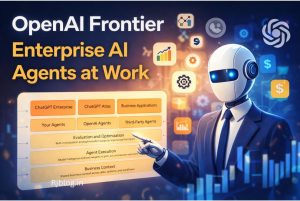
Artificial intelligence has spent the last few years proving it can generate content on demand. With the introduction of Frontier, the focus is clearly shifting toward something more practical — AI that can actually execute real work inside organizations.
Instead of positioning AI as another productivity tool, Frontier represents a move toward systems that behave more like persistent digital co-workers operating across business software, data, and workflows.
This shift reflects a larger trend already visible across the industry: enterprises are no longer experimenting with AI only for automation, but are now exploring how AI can handle multi-step operational responsibilities.
From Assistant to Active Operator
Traditional AI deployments are mostly reactive. A user asks a question, receives an answer, and the process ends.
Platforms like Frontier aim to change that model by enabling organizations to deploy AI agents that can:
- Plan complex workflows
- Access internal systems and structured data
- Execute tasks across multiple applications
- Maintain context across long-running projects
In practical terms, this means AI can move beyond drafting emails or writing snippets of code and start managing complete processes from start to finish.
For developers already experimenting with agent-based coding environments, this evolution aligns with the rise of advanced autonomous development systems such as GPT-5.3 Codex-style agentic models — which you can explore further here:
https://rjblog.in/openai-gpt-5-3-codex-agentic-coding-model/
Why Enterprises Are Paying Close Attention
Many organizations have struggled to scale AI pilots into production environments. The biggest barriers have not been intelligence, but governance, reliability, and integration with existing tools.
Frontier-style systems attempt to solve this by introducing:
- Permission-based access controls
- Auditable activity logs
- Centralized management of multiple AI agents
- Compatibility with existing enterprise software
If successful, these features could significantly reduce friction for companies that want AI embedded into everyday operations rather than limited to experimental use cases.
This also connects with an ongoing developer debate about which AI platforms offer the best real-world productivity benefits. For a broader comparison perspective, you can see how developer workflows differ between leading systems here:
https://rjblog.in/claude-ai-vs-chatgpt-for-developers/
A Growing “AI Workforce” Model
The emergence of agent-driven platforms suggests a deeper transformation in how digital work is structured.
Instead of AI simply accelerating individual employees, organizations may begin assigning entire categories of repetitive or data-heavy tasks to autonomous systems — with humans providing oversight, strategic decisions, and exception handling.
Examples of early enterprise use cases being explored include:
- Automated reporting and analytics
- IT troubleshooting
- Customer support ticket resolution
- Internal documentation management
As AI becomes more embedded in daily workflows, reliability and stability also become critical. Even small technical disruptions can affect productivity, which is why operational issues like platform loading errors remain a practical concern for teams using these tools at scale. If you’ve encountered that recently, this guide may help:
https://rjblog.in/chatgpt-unable-to-load-projects-fix/
The Broader Ecosystem Around Frontier
Frontier’s arrival also highlights another important direction: AI is moving beyond screens.
Voice-first and ambient computing concepts are gaining traction, suggesting that enterprise AI may eventually operate through wearable or always-available interfaces rather than traditional apps.
That idea aligns with emerging experiments in hardware-integrated AI experiences — something explored further here:
https://rjblog.in/openai-ai-earbuds-future-voice-first-device/
Taken together, these developments indicate that the next generation of AI won’t just live inside chat windows — it will be embedded into the tools, devices, and environments people already use every day.
What Comes Next
Frontier represents an early step toward large-scale deployment of coordinated AI agents inside real business environments. The coming months will likely determine how effectively these systems can operate across complex organizational structures without increasing risk or oversight burden.
The bigger picture is clear: AI is transitioning from a productivity enhancement to an operational layer inside modern companies. Organizations that successfully integrate agent-driven workflows could gain measurable efficiency advantages, while others may need to adapt quickly to remain competitive